
Although I love creating original ESL lesson plans from scratch, tailored to the interests of my students, the reality is that it’s not doable most of the time. The average English teacher teaches between 25-30 hours per week, leaving only 5-10 hours for lesson planning. It’s just not possible to customise every lesson, which is why ESL lesson plan websites are such a gift, especially as a new TEFL teacher. Here are my top ten:
- Eng Hub (teens and adults)
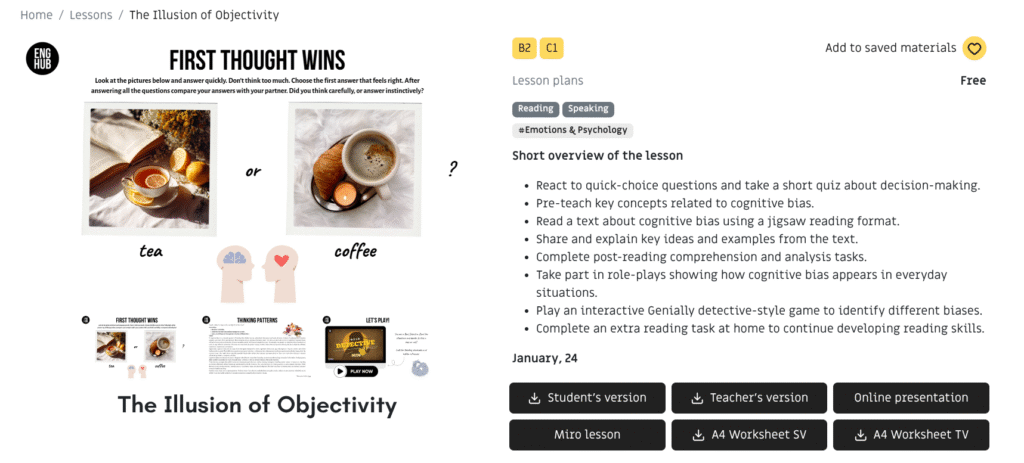
This is by far my favourite ESL lesson plan website for teenagers and adult students. Not only are the designs of the lesson materials clean, inclusive and beautiful, but they cover so many different topics, particularly for upper intermediate and advanced students. They have plenty of warmer activities and complete lesson plans that include games, presentations, and pdfs. They are aesthetically pleasing and it’s the only ESL lesson plan website where the lessons, in my opinion, need no adjustment whatsoever. If you work online for the majority of the time (which I do), it’s perfect.
- Your English Pal (adults)
Your English Pal provides complete ESL lesson plans for teaching adults, and shines specifically in the area of Business English. They provide a reliable, easy-to-follow format for each of their lessons, all based around a specific topic. The format is (usually) as follows: discussion questions to introduce the topic, a vocabulary exercise with words and idioms specific to the topic, more discussion questions using the vocabulary in context, a video (between 6-15 minutes long), discussion questions based on the video, and an extra task. The videos are always thought-provoking and educational (mostly TED Talks) which I have learned a lot from. Through this ESL lesson plan website, I have acquainted myself and my students with a wide range of philosophical concepts, thought experiments and different perspectives on the world.
- Linguahouse (teens and adults)
Linguahouse features ESL lesson plans which are often centered around an interesting authentic material, whether it’s an article, an audio clip, or a video. They provide lots of vocabulary exercises and really focus on the grammar (unlike the previous two websites, which are more focused on conversation). Some of their lessons centre on specific historical figures, such as Ada Lovelace (the world’s first computer programmer) and Harriet Tubman (an anti-slavery activist). It gives students the opportunity to reflect on our shared history and keeps it alive at the same time. They offer lesson plans in English and Spanish.
- ESL Brains (teens and adults)
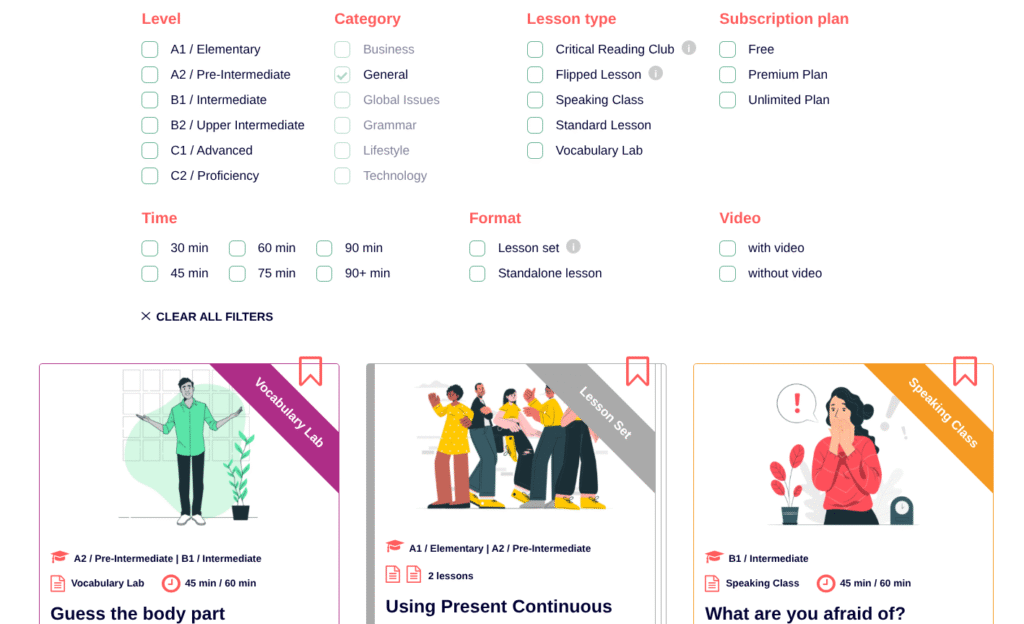
I was introduced to this ESL lesson plan website when I first started teaching English and I have been using it ever since. It gives teachers the option to filter on specific levels and skills (reading, speaking, listening, etc), lesson length (30-90+ minutes), with/without video, categories, and more, with three tiers (free, premium, unlimited). All the lessons are comprehensive and educational, using different resources from across the web. One of my favourite lessons from this platform was one on AI, which I was able to customise as a result of their easy-to-use Google Slides option.
- Twinkl (kids, teens and adults)
My friend told me about this ESL lesson plan website about a year ago, but I was reluctant to use it until recently. The reason I took so long to join it was because you have to subscribe, and I wanted to avoid another subscription. However, I am so glad I did and it is 100% worth the money. It is by far the best and most reliable website for ESL lesson plans for kids, and it’s not even designed specifically for it! In addition to English as a second language, they offer fun, genuinely engaging materials for maths, arts and crafts, Spanish and more. One of the best things about this website is how inclusive it is: the materials often feature people from the disability community, and other mariginalised communities. Representation matters, and Twinkl represents learners from all walks of life.
- British Council (teens and kids, Cambridge preparation)
Although the exercises on this website don’t quite cover a full hour (at least not in my case), it is an invaluable resource for listening and reading practises for A1-C2 levels. The preparation tasks pre-teach the students the important terms from the materials they will listen to / read, and there is always a post-reading/listening discussion question. Their materials are available online (used interactively) or offline, as downloadable PDFS. It’s versatile and reliable.
- ISL Collective (kids, teens)
ISL Collective is a great resource for worksheets, particularly when you want to hone in on a specific grammar point. As suggested by the name, it’s a “community of ESL/EFL teachers publishing self-created English language worksheets”. As the materials are completely user-generated, it’s important to double-check them before you use them in your lesson. However, with over 186,000 worksheets, you will never be in short supply.
- Game Gal (Kids and teens)
Although this is not an ESL lesson plan website, I use its word generator feature so frequently that it would be a sin not to include it in this list. I use it as a warmer, a brain break, or simply a way to get my students talking. I set a timer on my phone for three minutes (or this bomb timer for students who enjoy a bit of drama) and play taboo with them, trying to work together to guess as many words as possible in that time. I have Google Translate open in another tab so that students can look for words they don’t know (thereby expanding their vocabulary). After the three minutes is up, we do another ‘round’, aiming to beat our last score. The best part about it is that it happens almost every time, so there’s a real sense of progress.
- Bamboozle (kids and teens)
My TEFL experience has taught me that kids cannot get enough of Bamboozle. The gamification features and rewarding gif at the end is a surefire way to get the whole class engaged. I have even used it for online adult classes, with great success. The only thing to note is that all the games are 100% user-generated, which unfortunately means there are occasional errors (not ideal!). However, as long as you double-check the content, you will be fine.
- Wordwall (kids and teens)
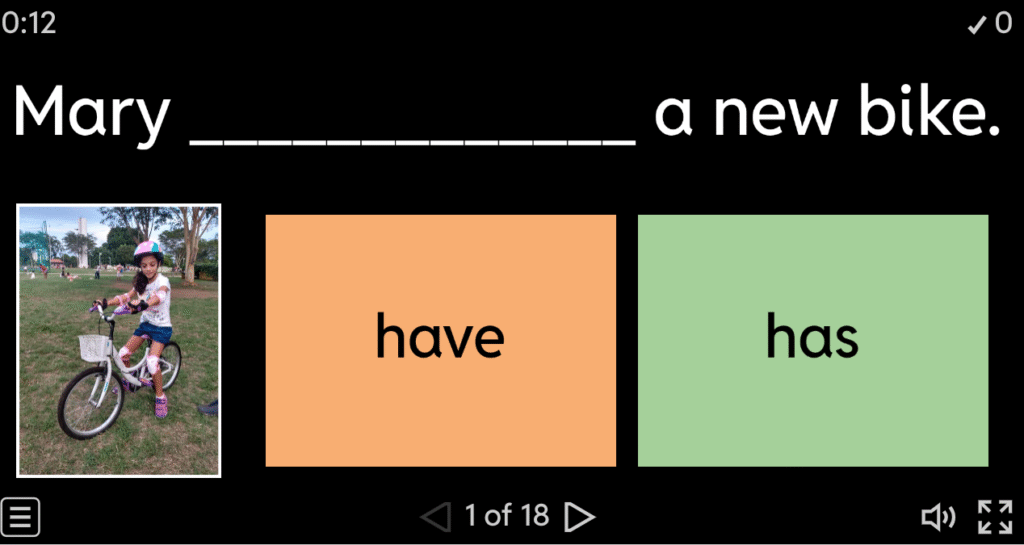
I love Wordwall for creating customised matching activities. It is fantastic for gamifying vocabulary-learning and features matching games, memory games and game-show style quizzes. I recently discovered my always-distracted, 9-year-old online learner loves Memory, and this has been invaluable for engaging him and forcing him to use his English. Like Bamboozle, the games are completely user-generated, so it’s important to double-check the content before using them.
Do you have an ESL lesson plan website that you would recommend? Share it in the comments below!