
This lesson is designed primarily for upper-intermediate to advanced students (B1.2-C2), but can be adapted for lower levels, too. It requires access to a computer (story needs to be typed) and ChatGPT, or another image-generation AI service. It was designed for a one-on-one online class, but can be adapted for a small group of students working together.
Storytelling provides endless opportunities to practise narrative tenses, build vocabulary, and (most importantly) get your students communicating effectively and confidently in English. The beauty of storytelling is that it relies on the student’s own imagination, naturally making it a more engaging way to learn.
I was initially inspired to create this lesson by a 12-year old student of mine who will eventually take his HSC exam. He is not an ESL student, but he will be required to identify narrative devices, discuss intertextuality, and write short, engaging stories. There are already endless examples out there of cross-media adaptations which we could have examined together (and in all likelihood, will). From high school, I specifically remember studying Looking for Alibrandi, various Shakespeare adaptations, andThe Outsiders. However, I also remember the ire most of the boys in class seemed to have for these assignments, and wanted to introduce the topic of intertextuality in a more interesting way.
Enter AI.
For the longest time, I had outright refused to use it and I’m still (generally speaking), not a huge fan. AI has been linked to brain rot, mental health problems, environmental horrors, and intellectual theft. The AI service used in this lesson, for example, has been trained on the work of thousands of illustrators who have not been credited or paid. That is a harsh, uncomfortable and undeniable fact.
However, even I have to admit that there are things that AI can do that humans simply cannot, and its benefits for teaching can range from significantly reducing lesson planning time to preparing students for the TOEFL iBT 2026. In this particular case, it’s used to produce an image based on a prompt within seconds.
A summary of how to run this ESL lesson
Here’s a 5-step overview of how to run this ESL lesson. Details are included below.
- Storywriting (the student writes a short story, with you as their guide).
- Error correction and ‘upgrading’ the story.
- Using AI to generate a comic strip based on the written story.
- A robust discussion revolving around the relationship between the two ‘texts’.
- Tweaks to the visual component and follow-up discussions.
Short story writing
Choose a genre
For students of advanced ability, choosing a genre will pose an extra challenge to their storytelling abilities while simultaneously getting them more invested in the activity. My student, for example, chose the horror genre. It is not something that I would have proposed, but it gave him agency and his clear interest in the genre led to more meaningful engagement. Choosing a genre also helps to narrow things down and get more specific, from genre-specific adjectives (such as adjectives found in this list of 100+ scary words) to appropriate idioms (like 40 idioms for Scary).
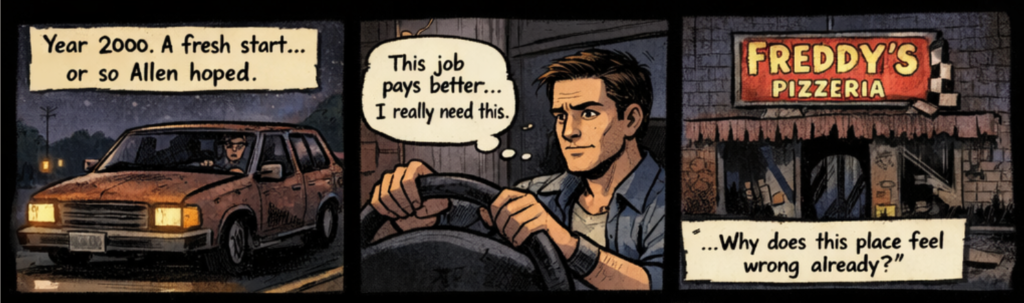
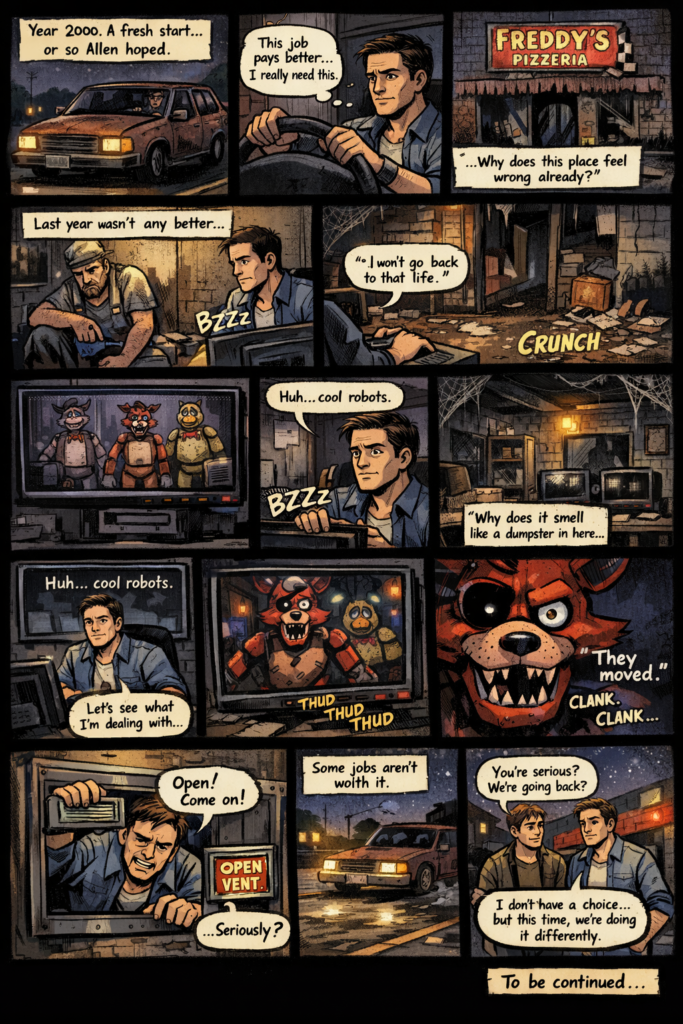
Snippet from a student’s story. The setting was based on the videogame Five Nights at Freddy’s and the scene set by using adjectives such as “eerie”.
Create a main character and plot line
Run through the usual character, setting, problem, and solution set-up. There are many guides for this online, including my own A series of epic stories activity. Ask your student: Who will be your main character? What do they look like, what are they afraid of, and what is their main motivation?
If your student needs some inspiration, ask them to base it off an existing character, whether it be a favourite character of theirs from a videogame series, tv show or movie. Although students will be required at some point to create their own characters, for the purpose of this task and practising their English, existing characters work a treat.
Tap into the five senses to set the scene
Sometimes, it can be difficult for a student to imagine where the story will take place. Questions such as “In which historical era is your story taking place? At what time of the day and in which season?” can provide a good starting point. I’ve found a great way to inspire your student to set the scene is to tell them to imagine what their five senses would be experiencing in that place, at that time.
Here’s how the conversation with my student went (with some embellishments):
Me: Imagine you’re in this place. What can you see in front of you?
Student: I can see a pizzeria.
Me: Tell me more about the pizzeria. Use three adjectives at least. For example, is it full of people or empty? Is it clean? Does it look like a place where you’d want to eat?
Student: It’s old and dirty, and the light-up sign isn’t working well. It’s closed.
Me: Is it night or day? What’s the weather like?
Student: It’s night time and it’s very dark. There are lots of clouds in the sky and it’s a bit misty.
Me: How does it feel to be standing there, outside the pizzeria?
Student: It’s cold. It’s a little bit windy, but not too much.
Me: Can you hear anything?
Student: No. Actually, maybe yes. Something is making a creaky noise somewhere, but it’s quiet otherwise. Maybe the sound of a bat?
Me: What can you smell?
Student: It smells bad. It smells like trash.
Me: Can you see the trash somewhere?
Student: Yes. There is a big trash pile next to the old pizzeria. There are some rats which are eating some stuff from it.
If your student is feeling truly uninspired or needs something to get their imagination going, use the web! Google “scary scene” and get them to choose one of the scenes to base their setting on. This helps the student really imagine themselves there and gives them something to work with instead of just pulling it out of the air.
Create the skeleton plan with them and then give them some time to create the narrative.
Plan out the story with them, paragraph by paragraph. For each one, suggest some language that could be useful (tailored to the genre and story). It might look something like this:
Paragraph one: Introduce main character and set the scene (background)
Examples of useful language: Once upon a time, there was …….., There was once a ……
Paragraph two: Introduce the time and place of the day the main event/conflict will happen. What happens before the conflict/event?
Examples of useful language: “One day, (main character) was ……”, “On a cold evening in ……, (main character) was…”
Paragraph three: Describe the conflict/main event.
Examples of useful language: “All of a sudden, there was a …….”, “Without warning, there was a ….”
Paragraph four: Consequences/results of the main conflict / event.
Examples of useful language: “It was devastating. The townspeople were …..”, “….. had caused a lot of problems for …, including…..”.
Paragraph five: The main character’s actions in response. The solution.
Examples of useful language: “(Main character) decided this was unacceptable and decided to take action.”, “The townspeople gathered together and …..”
Paragraph six: The story’s end (resolution)
Examples of useful language: “(Main character) had saved the day!”, “….. lived happily ever after.”
They’ll need some time to write their stories, so make sure you have this planned in. In an ESL classroom setting, this will provide an opportunity for group work (all discussion in English, of course!) and to monitor and listen out for emergent language. Circle the room to ensure all students are on track (on task and on schedule).
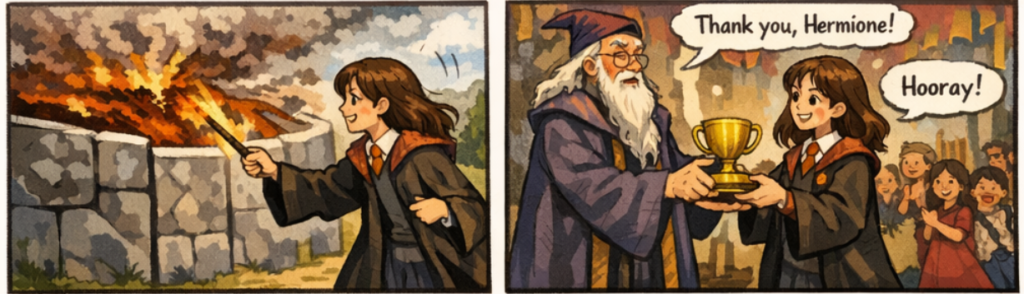
A snippet from a student story in which Hermoine is the heroine.
Error correction
Once the story has been written, the most important thing to begin with is praise. Communicating in a second language is a nerve-racking experience which can leave students feeling vulnerable, so make highlighting your favourite parts of the story your first priority.
After giving lots of encouragement, tell your student that, as great as their story is, it could be even better. Highlight some words you feel are a little lacklustre (e.g. “good”), and encourage them to find a better word. I have found Thesaurus.com to be a phenomenal resource for this. Also highlight ‘gaps’ in the text which you feel could be more robust. Give them a list of idioms to choose from which could help fill the gap, or give them prompts. E.g. “Here you’ve written that he crawled through the air vent and escaped. What were his senses experiencing while he was doing this? How did he feel? What did he see? What did he hear? How did he get out of the vent?”. Through a gentle, guided discussion, you can help the student build on their story in a non-critical way which still gives them agency.
Once you’re both satisfied, get them to read the story aloud, correcting pronunciation errors at the end of the reading (so as to not interrupt them). Heap more praise on the end product. They’ve written a story in a language that’s not their mother tongue – that is amazing!
AI image generation: From epic story to epic comic strip
Open ChatGPT, or a similar AI platform which offers image generation functionalities, and type the following prompt in:
Generate a visual comic strip of 10-12 panels based on this short story: (copy/paste the student’s short story).
The image will take around a minute to generate. During this time, encourage your student to make predictions about what ChatGPT’s rendition of their story will be like. Will the character look the same as they envision? If details weren’t provided about what the main character was wearing, get them to make a prediction about what ChatGPT will clothe them in. What other visual ‘gaps’ might ChatGPT fill in? These questions can be prepared in advance of the lesson, or on the fly. Either way, it builds anticipation and promotes discussion.
The student sees their story come to life
Seeing their story come to life visually is the reward for the work the student put in. Not only does it give them a sense of accomplishment (a literal picture of their language success), but it also visually reinforces any vocabulary they’ll have learned. You now also have a goldmine resource with which to practise other grammar points and functional language.
Practicising reported speech
Students can swap their visual stories (if they’ve created them individually or in small individual groups) and report on the speech of different characters (e.g. “She cried for help and the superhero answered her.”). Depending on the genre, you can encourage your students to use specific reported speech verbs.
For example, in the horror/drama genres, you could provide this list of verbs:
- Cried
- Screamed
- Begged
- Simpered
- Grovelled
- Growled
- Snarled
- Threatened
Speculative language
Swapped visual stories can then have their plots mulled over by classmates, practising functional language for expressing speculation. Here are some examples:
- Based on this scene, I believe that……
- Considering the …. in this scene, it’s possible that ….
- I imagine that what’s been written is ……
- It seems to me that this character is …….
- Looking at the …. in this scene, I’m of the mind that …..
Students can present their theories to the class/teacher (if in groups), or the ‘creator’ can present their visual while the class speculates. Whichever format you decide is best, it will no doubt facilitate interesting and amusing class discussions.
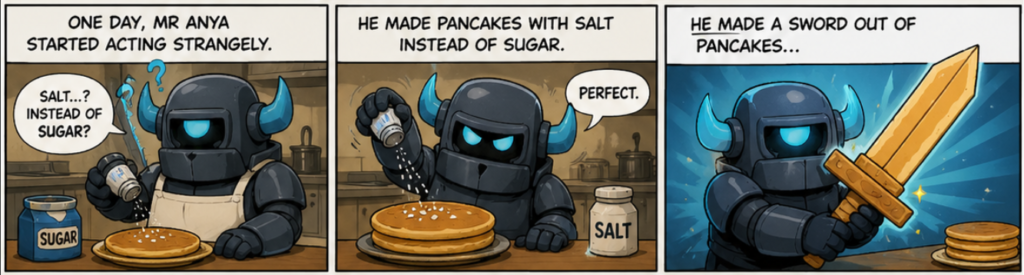
A snippet from a student story. Students could speculate: “I believe he’s acting strangely because ….”, or “Based on his facial expression in the second panel, I think that …”
Comparatives
Compare the original text with the ChatGPT rendition. How is it different? How is it the same? For example, is the main character older than you were expecting? Younger? Taller or shorter? Ask them to compare the setting with how they’d imagined it.
Discussions of intertextuality
Coming back to intertextuality, the way ChatGPT ‘interprets’ the story is also a fantastic way to generate discussion. Possible discussion questions include:
- Was the rendition accurate? Why or why not? Did it draw on any stereotypes?
- Which ‘gaps’ did ChatGPT fill in?
- What did it get wrong? Why do you think this happened?
- Which elements of the interpretation were different from what you were expecting? Talk about the character’s looks, age, what they’re wearing, and their facial expressions.
- Did the change from text to comic strip change the story somehow? In what way? What was gained and what was lost?
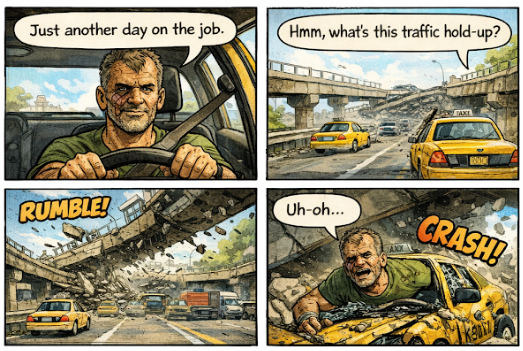
An example of where it went wrong, and an opportunity to discuss and use modal auxiliary verbs. For example, “The bridge shouldn’t have already been destroyed in the second panel.”, or “He should not be so big in the last panel.”
Follow-up task: Tweaking the story and generating new images
The next step is to type a new prompt into ChatGPT to tweak the story a little bit and see how that changes things. Students can make predictions about how their new prompt will change the outcome and then see if their predictions come to pass.
Some examples from my classes:
- “Use the same story, but now set in Australia/Antartica/……”
- “Use the same story, but change the genre from horror to comedy.”
- “Use the same story, but set 100 years in the future/past.”
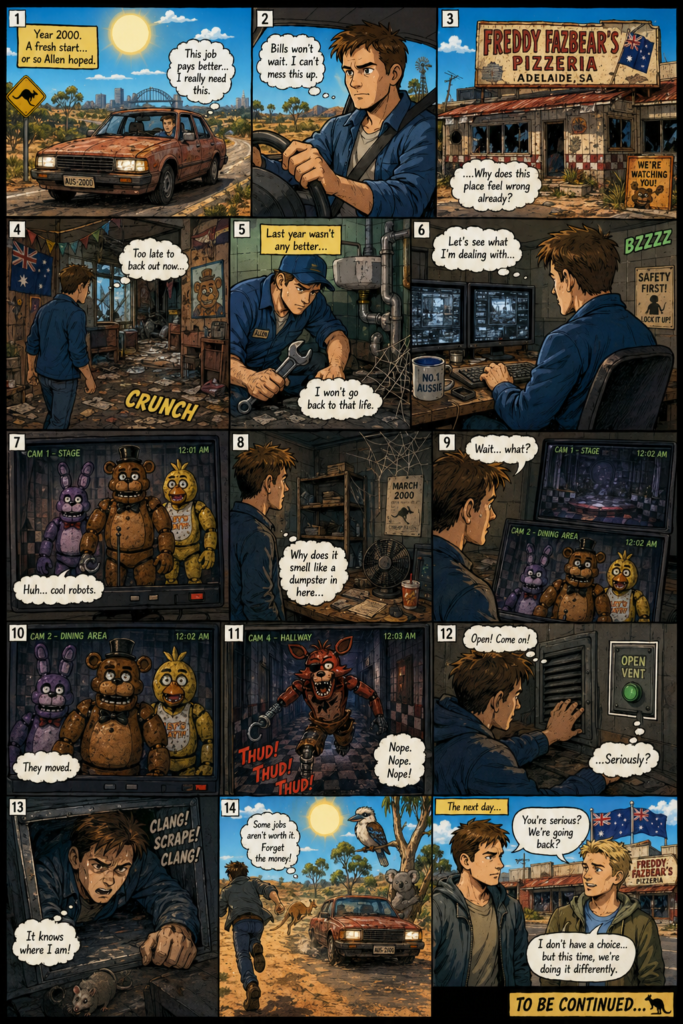
For example, my student and I discussed how a change to an Australian setting would impact the story. With discussion prompts such as “Will the weather be different?”, “What will the characters be wearing?”, and “What things might ChatGPT add, now that the story is in Australia?”, he rightly predicted that the new version would feature Australian animals, brighter colours and a big, blaring sun.
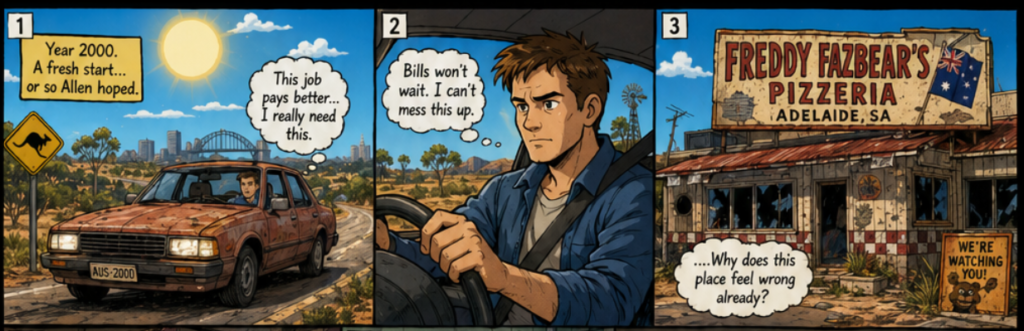
An Australian version of a snippet from a student’s story.
Possibility for lower-level students (A1-A2)
This lesson in its full form is ideal for upper-intermediate to advanced students, but can be tweaked for A1 and A2 students. A2 students can practise the past simple tense and basic vocabulary (covering almost any topic), and A1 students can practise present simple and basic dialogue. If they need more support, you can provide a skeleton of a story with blanks for them to fill in (Mad Libs-style). This still gives them agency to direct the story, characters, and setting.
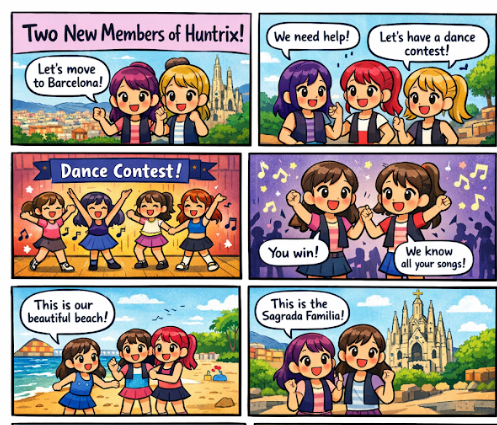
You can also create an AI-generated version of a comic strip ‘featuring’ your students alongside their favourite characters (provide the chatbot with first names only and a basic physical description – nothing that could actually identify them, of course!). They could practise basic dialogue and ‘interact’ with their favourite pop-culture sources in a whole new way.
Below is an example from a lesson with two of my youngest students. It depicts them giving a tour of their city to their favourite characters (the Huntrix group) after winning a contest of their favourite activity (dancing).
The takeaway: I (begrudgingly) admit that AI for ESL teaching is useful
After resisting the use of AI for my lessons for a long time, I can happily say I have found a middleground. This lesson provides a way to use AI to boost student creativity, rather than dampen it, and to promote critical thinking, rather than brain rot. In this case, it’s a language learning tool instead of a passive translator.
How do you use AI for ESL? Share your thoughts and comments below!
Gallery of student stories and their visual components (Real-life examples from my incredible students)
Security Guard Nightmares, by Netush (12)
Allen was on his way to the pizzeria for his new job as a security guard to earn some money. He needed money since he was running out and he had to pay the bills. He felt confident about this new opportunity since it made a bit more money than his old job. He decided to take his rusty car since that was the fastest way.
On the way there it was a clear night sky and all he could see were dim lights in houses. When he got there he had an eerie feeling just from entering the building. There were smashed windows, all the lights were out and it smelt like trash. He didn’t want to do this but he had to, and it was a new century so he was going to work harder this time. The year before, he had to work as a plumber and he was not paid a lot. It was the year 2000 and he was determined to earn enough money to make his life better again.
He went into the security office and sat down in the chair and turned on the cameras. When he looked at the screens, he saw some animatronics. These were huge robots that were kind of in the shape of people, designed to simulate lifelike motion and behavior. “Cool robots,” he said to himself.
He looked around the office to see what was there. There were spiderwebs in the corners of the room and there were empty shelves. He heard nothing but the buzzing of the cameras and the smell was like that of a trash can. He felt scared and nervous since this didn’t feel normal. He looked back at the screens and saw something strange about the scene. Before, he could have sworn that he had seen them on the stage, but now they were not in the same room as they were before. Now they were staring at the cameras in the main pizzeria area. The robots had moved. He was frightened and he heard a humming noise with loud noises coming in his direction. He had a nightmarish feeling about what it was and looked back at the camera. A fox-looking animatronic was running his way!
The animatronic’s left arm was a dark reddish colour and his right hand ended in a pirate’s hook. Its legs were metal and robotic as it ran. He was so scared for his life and he realised he had to protect himself. He saw an air vent in the bottom right of the security office and thought he would hide in the vent so it wouldn’t find him. He tried to open the air vent by himself but that didn’t work. Then he realised there was a simple open button next to it to open the vent. “How did I miss that?” he thought. He was crawling through the vents when he heard the noises get louder. “He knows where I am,” he thought. He crawled as fast as he could through the vent to the nearest exit. He knew that if he left he would not get paid but it was better than risking his own life. He felt bad since he knew that he might lose another job. He was puffing fast and his heart was beating faster than it ever had in his life, but he knew he made the right choice. Once he got out, he ran for his life and decided to never come back.
Then the next day he had second thoughts. He needed to come back since he had almost no money and couldn’t lose another job since he could barely afford enough fuel to get anywhere. So he went inside again and decided to try to do another day at this weird pizzeria. He decided this time he would be more focused and actually investigate the whole place instead of going to the security office. Also he decided to bring his best friend to help him not to go insane by himself.
Tweaking the story with a prompt: “Now make it set in Australia”.
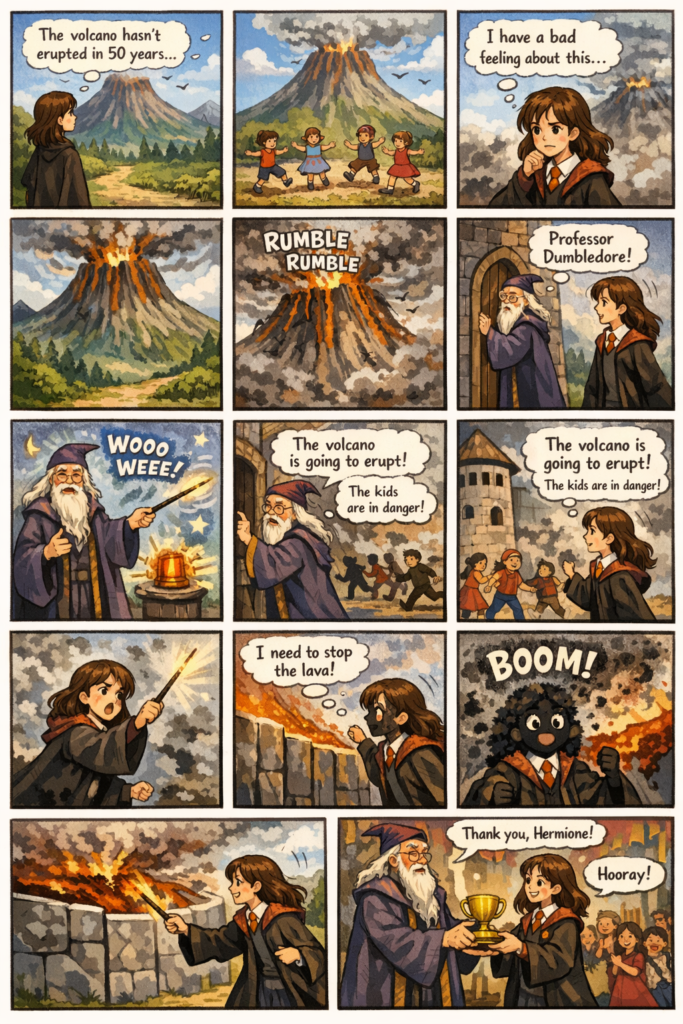
Hermoine saves Volcanoburg, by Chesha (9)
One day Hermonie was going for a walk towards the volcano behind her town, Volcanoburg. Birds flew around the volcano, while kids danced around the volcano. The tall, beautiful volcano had smoke whirling around the sky at its top, its sides were green and lightbrown. Birds chirped in the distance while kids were laughing.
She could hear a low rumble coming from the volcano. Smoke wafted through the air and filled her nose. Thoughts filled her head. She was worried. The volcano could erupt at any moment because it hadn’t erupted in 50 years. Smoke started rushing into the sky, filling the air. The rumbling got louder and louder. The ground started shaking.
Hermonie ran toward the tall building which Dumbledore lived in. She loudly knocked on the door, then remembered the kids. She quickly told him and ran back toward the kids to tell them to move. “The volcano is going to erupt!”. Dumbledore swirled his wand around, and created a siren. The townspeople evacuated. The ground was shaking crazily. Old trees fell everywhere.
Hermonie swung her wand in the air trying to cast a spell that could make a material to resist the lava. As hot lava dripped down the sides of the volcano Hermonie became more worried and she rushed a little bit. She accidentally messed up and BOOM her face was covered in black. Hermonie tried again, giving all her effort this time. She took her time this time but she didn’t go too slowly. Smoke had completely filled the sky. She finally did it! She touched the lava with a block of her material to check if it worked, and it did.
Herminonie quickly surrounded the volcano with the block of material and ran towards Dumbledore and where the town evacuated to to tell the good news. Herminonie ran excitedly as smoke followed her. Then she arrived and told everyone the good news.
After a day everyone cheered for Hermonie at a ceremony in her honour. Dumbledore happily handed Herminonie her award for saving the town. Herminonie felt really happy and proud that day.
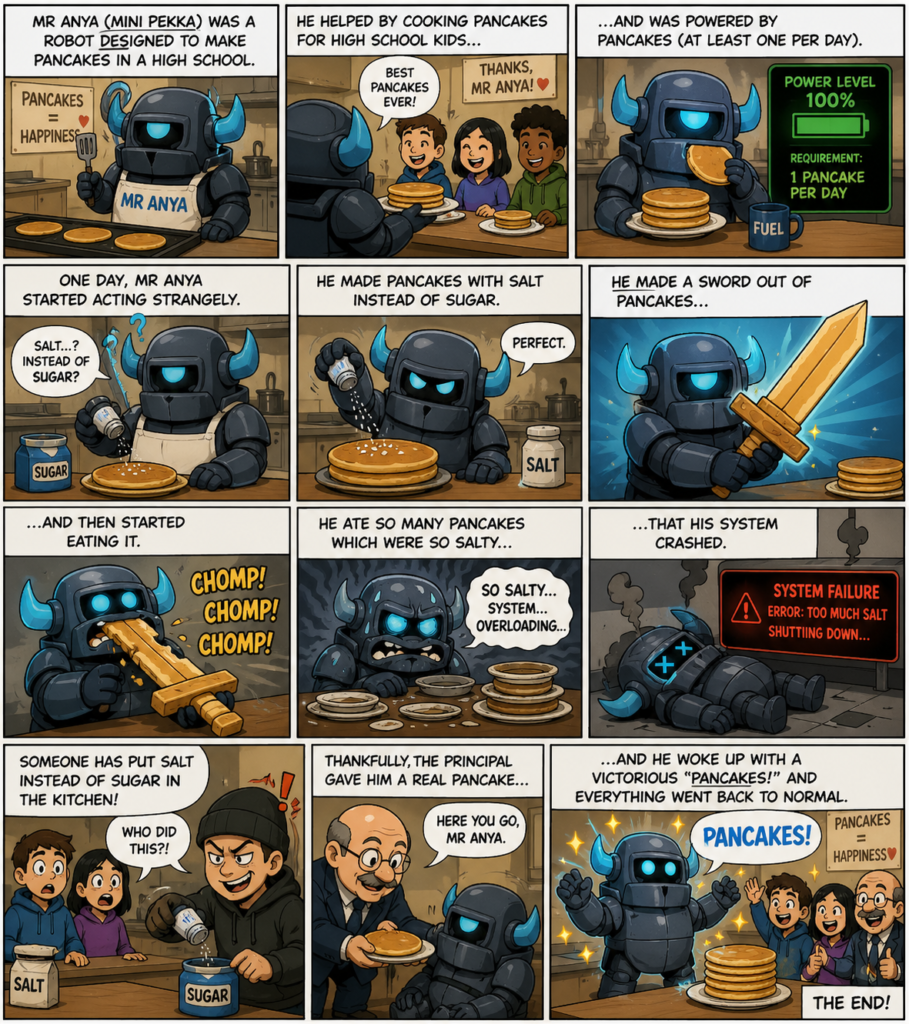
Pancake Robot Adventure, by Miquel (11)
Mr Anya (Mini Pekka, from the videogame Clash Royale) was a robot designed to make pancakes in a high school. It helped by cooking pancakes for high school kids and was powered by pancakes (at least one per day).
One day, Mr Anya started acting strangely. He made pancakes with salt instead of sugar. He made a sword out of pancakes and then started eating it. He ate so many pancakes which were so salty that his system crashed. Someone has put salt instead of sugar in the kitchen!
Thankfully, the principal gave him a real pancake and he woke up with a victorious “Pancakes!” and everything went back to normal.
Great use of creative tools to make learning engaging. It really connects with the new generation and encourages students to use AI properly to boost their creativity.
Thank you for the lovely comment! 🙂